

STEM Education Rooted In An Integrative Theory of Learning
About RISE
Our approach integrates a holistic learning framework, featuring the RISE principles (Nasir et al., 2021), into a model for postdoctoral training that prepares the next generation of diverse STEM education researchers. The RISE principles hold that learning is:
Rooted
Rooted in basic biological and cognitive processes
Integrated
Integrated with socioemotional and identity development
Situated
Situated in and shaped by social and cultural contexts
Experienced
Experienced as embodied and socially coordinated
Program Overview
Focus
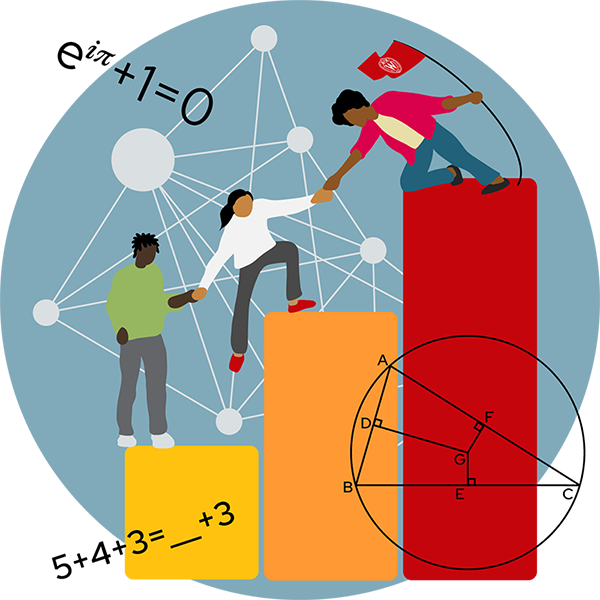
The program’s specific focus will center on mathematics education and mathematical cognition through the gaze of the RISE principles.
Mentorship
The program will draw upon the expertise of our interdisciplinary group of scholar-mentors to nurture a cohort of junior researchers who are prepared both to push the frontiers of inclusive STEM education forward and to train successive generations of STEM researchers.
Research & Education Training Plan
The program will support fellows in deepening their membership in scholarly communities of practice, using a research and education training plan that features five key components:
Development of professional competencies such as publishing, grant writing, and navigating the job market
- Individualized mentorship
- Research apprenticeships on existing projects
- Support for independent research according to fellows’ interests and guided by their primary mentor
- Interdisciplinary training above and beyond mentored research. (e.g., coursework, workshop participation, and explicit training in STEM public service learning)
- Development of professional competencies such as publishing, grant writing, and navigating the job market
Contact Us
For more information, please contact our program manager, Jason Roth, at RISEPostDoc@wcer.wisc.edu.
Our research is funded through a grant from the National Science Foundation (NSF). Any opinions, findings and conclusions or recommendations expressed in this material are those of the author(s) and do not necessarily reflect the views of the National Science Foundation.